- support@ddgear.com
- North 3F, Building 13-2, Zhixin Park, NO.1099 Xianhua South Street, Wucheng, Jinhua, Zhejiang, China.

Case
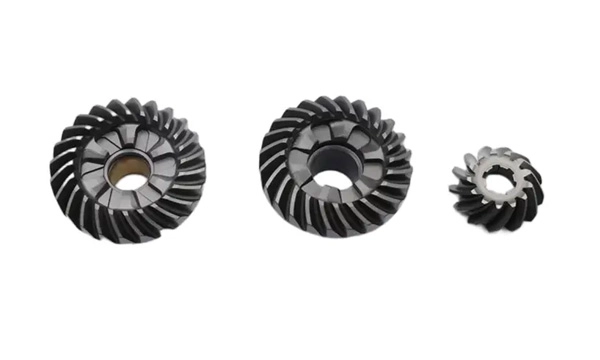
Outboard Motor Gear – Spiral Bevel Gear for Marine Lower Units
Case Highlights
A boat drive manufacturer producing outboard gearboxes for mid-power engines was facing complaints about gear whine at cruising speed and pitting on the spiral bevel gear set in salt-water use. The lower unit on a marine engine runs fully immersed, exposed to salt water and corrosion; if protection is poor, the housing and gears can suffer severe damage over time.
DD Gear engineered a hardened spiral bevel gear pair for the outboard gearbox, using marine-grade alloy steel, fine grinding and improved surface protection. Spiral bevel gears with curved teeth engage gradually, giving smoother and quieter operation and high torque capacity in right-angle drives—ideal for marine propulsion. After field trials, the OEM saw noticeably lower gear noise, better contact pattern stability, and longer service intervals on heavily used boats.
Customer Background & Project Scope
Customer industry: Manufacturer of outboard motors and lower-unit gearboxes for leisure boats.
Application: Spiral bevel gear pair in the outboard’s right-angle gearbox (engine crankshaft → vertical driveshaft → spiral bevel set → propeller shaft). Bevel gear shafts are critical components in marine propulsion, transmitting power from engine to propeller.
Operating profile:
Frequent acceleration and deceleration, including hard gear shifts.
Long hours at partial and full throttle in salt-water conditions.
Project goals:
Reduce gear whine at typical cruising rpm.
Improve pitting resistance and contact fatigue life of the spiral bevel pair.
Maintain the existing housing and shaft layout to avoid redesign of the lower unit.
Challenges
Gear noise in the lower unit
Existing gears generated a tonal whine at mid-range rpm.
The previous spiral bevel set had less-than-ideal tooth contact; misalignment and surface finish issues can increase vibration and noise, shortening gear life.
Wear and pitting in salt-water use
After several seasons in salt water, some gear pairs showed pitting and micro-spalling at the contact zone.
Spiral bevel gears for marine work must withstand high torque, impact loads and a corrosive environment, so material and surface treatment choice is critical.
Tight packaging & alignment sensitivity
Spiral bevel gears need accurate alignment and tooth geometry to perform well; they are manufactured to very exacting specifications.
The new gearset had to fit the existing cone clutch, bearings and seals without changing mounting dimensions.
DD Gear Solution
1. Spiral Bevel Gear Design
Tooth geometry & contact pattern
DD Gear refined the tooth geometry, spiral angle and contact pattern using 3D modeling and contact analysis, so the load sits near the central region of the tooth and remains stable under deflection. Modern design methods for spiral bevel gears use static, dynamic and thermal load calculations to ensure durability.
The spiral angle was chosen to balance smooth, quiet meshing with acceptable axial loads on tapered roller bearings; a larger spiral angle improves smoothness but raises axial force.
Pattern-matched pinion & gear
Each pinion–gear pair is matched so that contact patterns remain correct after assembly, similar to other marine drives that use pattern-matched spiral bevel gears to minimize gear noise.
2. Materials, Heat Treatment & Corrosion Protection
High-strength alloy steel
Gears produced from high-strength, wear-resistant alloy steel (e.g., SCM4xx / 20MnCr5 grade), consistent with recommendations that spiral bevel gear components use high-strength alloy or stainless steels for long-term, high-speed service.
Carburizing + quenching used to form a hard case over a tough core, raising contact fatigue strength.
Ground tooth flanks
Tooth flanks are precision ground, which improves accuracy, lowers roughness, and supports high efficiency in spiral bevel gear drives.
Corrosion and oil protection
Marine-grade surface protection (phosphate or similar) is applied before oil fill; internal surfaces are fully flooded with gear oil to protect against corrosion, as long-term storage and operation require good oil coverage to prevent rust.
3. Manufacturing & Quality Control
Accuracy & inspection
Spiral bevel gears manufactured to high accuracy class (ISO / JIS equivalent Grade 5–6); stock examples of hardened spiral bevel gears show similar module ranges and precision classes used for demanding right-angle drives.
Gear tooth profile and contact patterns are measured on dedicated gear measuring equipment; blue-contact checks verify mounting distances and tooth contact position.
Assembly & validation testing
Lower units with DD Gear sets were tested on a water-cooled dyno under varying rpm and torque.
Vibration and sound pressure were measured near the transom; gear oil samples were monitored for metal content during endurance runs.
Results
Noise reduction
Test data and sea trials showed noticeably lower gear whine at typical cruising rpm; the tonal component from the bevel mesh decreased when compared with the previous design. This matches the known benefit of spiral bevel gears with optimized geometry—smooth, quiet operation in high-speed right-angle drives.
Durability & reliability
After extended salt-water operation, the improved surface hardness and tooth geometry showed no early pitting within the OEM’s validation window.
The OEM reported fewer lower-unit failures related to bevel gears in warranty data for the updated models.
Drop-in integration
The DD Gear spiral bevel pair fit the existing lower-unit housing, bearings and cone clutch, allowing the OEM to update the gearbox without changes to casting or propeller shaft layout.
Typical Technical Specifications
Representative values; DD Gear customizes to engine size and gear ratio.
Item
Parameter
Gear Type
Spiral bevel gear pair, right-angle drive
Application
Outboard motor lower-unit gearbox
Module Range
m 2.0–3.5 (project-dependent)
Ratio
Typical 1.7:1–2.5:1 (engine rpm to propeller shaft)
Material
20CrMnTi carburizing steel
Surface Hardness
HRC 58–62
Accuracy Grade
ISO / DIN 6–8
Surface Finish
Ground tooth flanks, low roughness for reduced noise
Case Summary
By combining marine-grade alloy steels, precision-ground spiral bevel geometry, and careful corrosion protection, DD Gear helped this outboard OEM:
Reduce gear whine at cruising speed.
Improve contact fatigue life and reliability in salt-water service.
Upgrade the gearbox as a drop-in spiral bevel gear set without redesigning the lower-unit housing.
This approach suits outboard motors, sterndrives and other marine right-angle gearboxes that need compact, quiet and durable spiral bevel gears.
Designing or upgrading a marine outboard gearbox?
Contact our engineers to discuss spiral bevel gear sets tailored to your lower-unit layout and sea-water conditions.
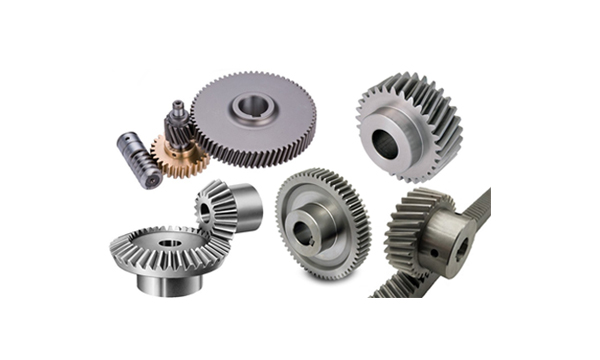
Cutting Machine Gear – Precision Helical Gear Set for CNC Cutting Lines, 30% Longer Service Life
Case Highlights
A European OEM of CNC sheet-metal cutting machines was facing premature gear wear and growing backlash on the X/Y gantry axes of its plasma and fiber-laser lines. This led to cut-edge steps, more scrap, and rising maintenance costs.
DD Gear designed a small-module helical gear set that fits into the existing servo gearbox envelope, improving smoothness and durability. After retrofit and one year of production use, the customer’s maintenance data showed around 30% longer gear life and about 50% fewer unplanned gearbox-related stoppages, while maintaining the required positioning accuracy of the cutting line. High-precision helical gears are widely used in industrial machinery because their angled teeth engage gradually, which reduces impact, vibration, and noise compared with spur gears.
Customer Background & Project Scope
Customer industry: European manufacturer of CNC plasma and fiber-laser cutting machines for steel fabrication shops.
Application: Servo drives for the X/Y gantry feed and Z-axis lifting of the cutting head on a high-duty production line.
Machine requirements
Positioning accuracy and repeatability in the order of ±0.02 mm across long travel, in line with common CNC machine-tool expectations.
16–20 hours of daily operation, with frequent rapid reversals.
Stable motion and low vibration to protect cutting quality.
The OEM had used a compact spur-gear reducer for many years, but as cutting speeds and duty cycles increased, the geartrain became a weak point.
Challenges
Fast gear wear and pitting
The existing small-module spur gears developed surface pitting and wear after roughly 12–15 months in high-duty shops.
Backlash growth translated directly into contour errors and visible “steps” on laser-cut edges.
Noise and vibration near the gantry
At higher traverse speeds, operators noticed pronounced gear whine.
Spur gears engage suddenly tooth-to-tooth, which tends to generate more vibration and noise at speed.
Limited space for redesign
The OEM wanted better performance without redesigning the whole gearbox housing or servo layout.
Any solution had to drop into the existing mounting envelope and keep the same ratios.
DD Gear Solution
1. Design Optimization
Switch from spur to helical gearsDD Gear’s engineering team replaced the spur gear pair with small-module helical gears, increasing the contact ratio so that multiple teeth share the load. This design is known to enable quieter, smoother operation and higher load capacity in industrial drives.
Micro-geometry & backlash control
Applied profile and lead modifications to keep transmission error low over the full face width.
Set backlash to a tight but safe window so that the servo system maintains stiffness without risk of jamming under thermal expansion.
Drop-in compatibility
Maintained shaft centers and hub interfaces to fit the customer’s existing cast housing.
Gear ratio tolerance kept within the servo tuning range, avoiding changes to control software.
2. Materials & Heat Treatment
Carburizing steel for long life
Selected 20CrMnTi carburizing steel, a standard high-performance alloy widely used for automotive and industrial gears thanks to its hard wear-resistant case and tough core.
Case depth set to 0.8–1.0 mm depending on tooth size.
Heat treatment & finishing
Carburizing + quenching followed by precision gear grinding on the tooth flanks.
Target surface hardness HRC 58–62 for high contact-fatigue strength; core hardness matched to resist bending loads.
3. Manufacturing & Quality Control
Small-module precision machining
Modules in the m 1.5–2.5 range require careful control of tool wear, rigidity, and burrs; these aspects are critical to avoid premature failure in small-module gears.
Accuracy grade
Tooth profile, lead, and runout controlled to ISO 1328 Grade 5–6, consistent with high-precision cylindrical gears for industrial applications.
Verification
100% inspection of key dimensions and sampling of tooth-form data on a CNC gear measuring center.
Trial gearboxes run under load on DD Gear’s test stand to confirm noise and temperature behavior before shipment.
Results
Within the first full year of operation across several customer sites, the OEM reported:
Approx. 30% longer service life before reaching wear limits, based on comparison with older spur-gear sets in similar duty.
About 50% fewer unplanned stoppages due to gearbox issues, helping fabricators keep cutting lines running to schedule.
Notable reduction in gear whine, especially at high traverse speeds; operators described motion as smoother and “less harsh”. This aligns with widely documented advantages of helical gears for noise reduction in industrial machinery.
The OEM has since adopted the DD Gear helical set as the standard configuration on all upgraded plasma and fiber-laser cutting machines of this platform.
Typical Technical Specifications
Exact values are tuned per machine model; the table shows a representative configuration.
Item
Parameter
Gear Type
Small-module helical gear pair
Module Range
m 1.5–2.5
Number of Teeth
18–32 (per stage, customized to ratio)
Material
20CrMnTi carburizing steel
Case Depth
0.8–1.0 mm
Surface Hardness
HRC 58–62
Core Properties
Tough core for bending & shock resistance
Accuracy Grade
ISO / DIN 5–6
Surface Finish
Ground tooth flanks, low roughness for reduced noise
Case Summary
By combining helical gear design, carburizing alloy steel, and ISO Grade 5–6 precision grinding, DD Gear helped this CNC cutting-machine OEM:
Extend gear life and reduce unplanned downtime.
Maintain tight positioning accuracy as machines age.
Improve operator comfort and perceived machine quality through quieter motion.
This solution is directly relevant for other CNC cutting, laser processing, plasma cutting and high-precision machine tool applications where small-module gears see high-speed reversing loads.
Planning an upgrade for your CNC cutting machine gearbox?Contact our engineers to discuss a custom small-module helical gear set for your motion axes.
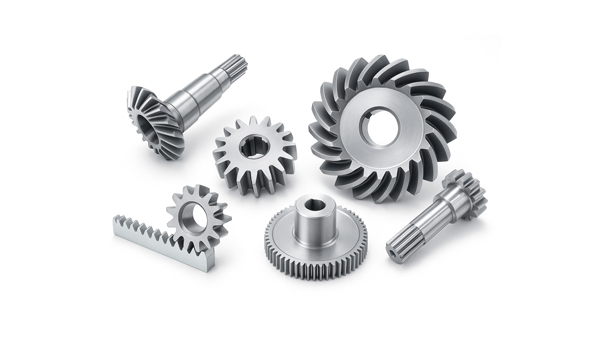
Automatic Door Gear – Low-Noise Gearbox Upgrade for High-Cycle Industrial Doors
Case Highlights
A leading Asian manufacturer of industrial automatic doors wanted to reduce noise and extend the life of its drive units used on warehouse and supermarket doors. Existing worm gearboxes were loud at peak speed and required overhaul every 2–3 years on busy openings.
DD Gear engineered a compact, low-noise gearset that fits into the same housing: a hardened steel helical input stage driving a bronze worm wheel output stage. After the change, typical door installations recorded about 5–6 dB lower operating noise at 1 m and roughly double the gearbox maintenance interval, while keeping opening/closing speed unchanged. Helical gears are widely used where quieter operation is needed, as their angled teeth engage gradually and distribute load over multiple teeth, reducing vibration and whine compared with spur gears.
Customer Background & Project Scope
Customer industry: Manufacturer of sectional and high-speed roll-up doors for warehouses, logistics centers and retail stores. High-cycle products often reach 200,000+ open/close cycles per year, similar to other commercial high-cycle doors.
Application: Motor-gearbox units that drive rolling drums or counterweight shafts on interior and exterior doors.
Project goals:
Reduce operating noise at typical opening speeds.
Increase service life of the gearbox in high-cycle locations.
Keep the outer dimensions and shaft positions of the drive unit unchanged for easy retrofit.
The OEM’s existing gearmotor design used a single worm-gear stage with relatively coarse tooth geometry. As sales volumes grew and doors were installed in noise-sensitive areas (retail, offices above warehouses), customer complaints and maintenance costs increased.
Challenges
High operating noise near the door opening
Door operators measured around 68–70 dB at 1 m during opening, perceived as intrusive in quiet indoor spaces.
The direct sliding action in the worm mesh and coarse tooth form contributed to whine and vibration.
Limited gearbox life in high-cycle doors
On doors exceeding 150,000 cycles/year, the bronze worm wheel showed wear steps and pitting after 2–3 years.
Backlash increased, causing a “clunk” when starting and stopping, and required gearbox replacement to avoid failure.
Tight packaging constraints
The new gearset had to fit into the existing cast-aluminum housing, keeping shaft centers, mounting holes, and drum interface unchanged so that dealers could retrofit in the field.
DD Gear Solution
1. Design Optimization
Two-stage architecture
DD Gear added a small-module helical input stage between the motor and worm shaft.
The helical stage handles speed reduction and smooths torque fluctuations before the worm mesh, which helps reduce vibration at the final output. Helical gears generally run smoother and quieter than spur gears due to gradual tooth engagement and higher contact ratio.
Tooth geometry refinement
Optimized helix angle and profile modifications to balance load and axial forces within the existing bearing arrangement.
Re-designed worm and wheel tooth form to improve contact pattern and reduce local sliding stress in the most loaded positions.
Drop-in housing compatibility
Kept shaft spacing, overall length, and mounting interface identical, enabling the OEM to use the same casting and assembly jigs.
2. Materials & Heat Treatment
Helical input gears
Material: SCM415 carburizing steel, which is widely used for gears requiring a tough core and wear-resistant surface.
Heat treatment: Carburizing + quenching, then precision grinding; target surface hardness HRC 58–60.
Worm gear set
Worm: Alloy steel (quenched and tempered, surface ground).
Wheel: High-strength tin-bronze alloy with good wear resistance and damping, commonly used for worm wheels in high-duty drives.
Tooth flanks finished to a fine surface roughness to reduce sliding friction and noise.
3. Manufacturing & Quality Control
Accuracy & assembly
Helical gears manufactured to ISO / DIN Grade 6 accuracy; worm and wheel controlled for lead error and contact pattern.
Backlash measured and recorded for each gearbox type; assembled units are run-in on a test stand at rated torque and speed.
Noise and durability validation
Sample drives tested on an indoor rig; sound pressure measured at 1 m over multiple door cycles to benchmark against the previous design.
Endurance tests for a subset of units simulating >200,000 cycles to verify wear behavior.
Results
After introducing the DD Gear solution, the OEM recorded the following on several pilot installations and internal rig tests:
Noise reduction
Typical sound levels during door opening dropped by about 5–6 dB at 1 m, moving from the high-60s into the low-60s dB range. This aligns with published data showing helical gearsets can operate significantly quieter than spur-type arrangements under comparable conditions.
Subjectively, door motion was perceived as smoother and less harsh, especially at high-speed travel.
Gearbox life & maintenance
On high-cycle warehouse doors, expected overhaul interval increased from 2–3 years to approximately 4–5 years, based on accelerated test results and the first wave of field feedback.
Backlash growth over time was slower, reducing impact at start/stop and improving perceived quality.
Implementation
Because the new gearset kept the same housing and interfaces, the OEM could roll out the upgrade with minimal change to installation manuals and dealer tooling. Existing doors can be retrofitted during regular maintenance.
Typical Technical Specifications
Item
Parameter
Gearbox Layout
Helical input stage + worm gear output
Input Gear Material
SCM415 carburizing steel
Input Gear Hardness
HRC 58–60 (case)
Worm Material
Alloy steel, quenched and tempered
Worm Wheel Material
High-strength tin-bronze alloy
Gear Accuracy
Helical: ISO / DIN Grade 6
Output Torque
Up to 300–400 N·m (project-dependent)
Accuracy Grade
ISO / DIN 5–6
Duty Cycle
High cycle, 150,000–250,000 cycles/year
Case Summary
By combining a helical pre-stage, carburized SCM415 steel gears, and a refined bronze worm wheel, DD Gear helped this automatic-door OEM:
Lower operating noise to meet comfort expectations in warehouses and retail environments.
Extend gearbox life and maintenance intervals on high-cycle doors.
Implement the upgrade without changing housings or installation procedures.
This approach is ideal for manufacturers of industrial and commercial automatic doors who want to improve NVH and reliability while reusing their existing operator platform.
Facing noise complaints or frequent gearbox failures on your automatic doors?Contact our engineers to discuss a custom low-noise gear solution for your next door operator platform.
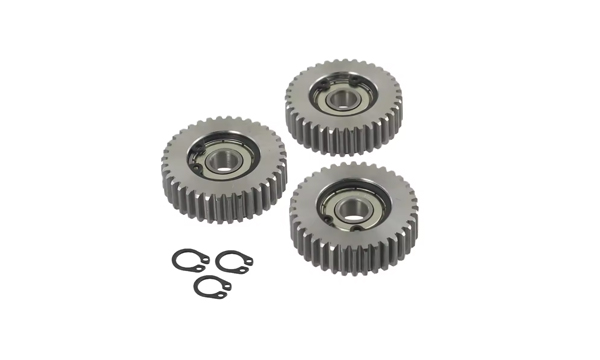
E-Motorcycle Gear – High-Efficiency Helical Reduction Gears for Urban E-Scooters
Case Highlights
An Asian OEM producing 3–5 kW electric scooters for city commuting wanted to upgrade the transmission between motor and rear wheel. Their existing spur-gear reducer generated noticeable gear whine at 40–60 km/h and showed wear after long hill-climb usage.
DD Gear designed a small-module helical reduction gear set that fits into the existing mid-drive housing. After validation on bench and road tests, the OEM measured around 2–3% drivetrain efficiency improvement and a clearly lower gear whine band at typical cruising speeds, while maintaining the same overall gear ratio. Well-designed helical gears are widely used in EV transmissions because they distribute load over a larger contact area, reduce impact, and help lower noise compared with spur gears.
Customer Background & Project Scope
Customer industry: Asian manufacturer of electric scooters and light e-motorcycles for urban mobility.
Vehicle segment: 3–5 kW mid-drive platform targeting daily commuting and food-delivery fleets.
Application: Two-stage reduction between high-speed BLDC motor and rear wheel via chain drive.
Project goals:
Improve mechanical efficiency of the reducer to support longer range on a fixed battery pack.
Reduce gear whine and vibration at 40–60 km/h cruising, where riders are most sensitive.
Keep the existing housing, motor mounting, and final drive ratio to avoid a full platform redesign.
The OEM’s original design used spur gears in both stages. As sales increased and scooters were used intensively in hilly cities, issues related to noise and long-term durability became more visible.
Challenges
Gear whine at cruising speeds
Riders and fleet users reported a high-pitch gear noise around 40–60 km/h.
Spur gears engage tooth-by-tooth, which tends to create more vibration and audible noise at high speed compared with helical teeth.
Thermal and load stress on hill climbs
During prolonged full-load hill climbing with passenger and cargo, teeth showed early pitting and polishing.
Elevated oil temperature and high motor speed increased stress on small-module teeth.
Packaging constraints
The customer needed a “drop-in” solution: same shaft centers, bearing positions, and external mounting, because the scooter frame and swingarm were already in production.
DD Gear Solution
1. Helical Gearset Design
Switch to helical teeth on the main stage
DD Gear replaced the primary spur pair with small-module helical gears, increasing contact ratio so that more than one tooth pair carries load at the same time.
Helical gears are commonly used in EV gearboxes because gradual tooth engagement reduces impact, vibration, and noise while maintaining high load capacity and durability.
Ratio and geometry optimization
Maintained the overall reduction ratio to keep vehicle performance (top speed and acceleration) unchanged.
Adjusted helix angle and face width to balance torque capacity, contact stress, and axial force within existing bearing limits.
Applied microgeometry corrections (profile and lead modifications) to minimize transmission error over varying loads, a known lever for gear NVH control.
Optional planetary second stage (for higher-end variant)
For a premium scooter version, DD Gear proposed a compact planetary second stage to increase torque density in the same volume.
Planetary gearboxes are widely used in e-bikes and e-mobility drives because they combine high torque, high efficiency, low backlash and low noise in a very compact form.
2. Materials & Heat Treatment
Carburizing steels for high contact fatigue strength
Selected 20CrMnTi / SCM420 carburizing steels for pinions and gears to achieve a hard, wear-resistant case with a tough core. Such steels are standard in automotive and EV transmissions.
Case depth set around 0.8–1.0 mm, depending on module and tooth size.
Heat treatment & finishing
Carburizing + quenching followed by precision gear grinding to achieve low surface roughness and stable contact patterns. This approach is consistent with modern EV reducer practices to raise mesh efficiency and reduce micropitting risk.
Target surface hardness HRC 58–62, with controlled core hardness to resist bending fatigue and shock loads from potholes or aggressive riding.
3. Manufacturing & Quality Control
Small-module precision
Modules in the m 1.0–2.0 range require tight control of tool wear, alignment, and heat-treatment distortion.
Accuracy grade
Gears manufactured to ISO / DIN Grade 5–6, which is appropriate for high-speed EV and e-scooter reducers where noise and efficiency are important.
Validation testing
Bench durability tests representing >25,000 km equivalent use, including repeated full-load hill-climb cycles.
On-road tests instrumented with sound measurements at rider position, comparing legacy spur design vs. new helical set.
Results
After adopting the DD Gear solution, the OEM reported the following:
Efficiency & range
Drivetrain efficiency improvement of about 2–3 percentage points in the most frequent operating range, based on dynamometer measurements.
In internal simulations and fleet tests, this translated into noticeably better real-world range per charge. (For reference, other EV gearbox studies show that optimized multi-stage gear design can yield a few percent energy benefit over conventional arrangements.
Noise & comfort
Clear reduction in gear whine in the 40–60 km/h band; rider feedback described the scooter as “quieter” and “more premium”.
Overall acoustic profile became more dominated by wind and tire noise, which is a typical target for well-designed helical EV gearsets.
Durability
After full bench cycles and initial fleet mileage, no pitting or scuffing was observed on tooth flanks within the test window.
Fleet operators experienced fewer complaints related to drive noise or abnormal vibration.
Integration
Because DD Gear kept shaft centers and housing interfaces unchanged, the OEM could implement the new gears in production with minimal tooling changes and no frame redesign.
Typical Technical Specifications
Item
Parameter
Gear Layout
Two-stage reduction (helical + spur / planetary)
Power Range
3–5 kW
Input Speed
Up to 4,000–6,000 rpm
Module (helical)
m 1.0–2.0
Material
20CrMnTi / SCM420 carburizing steel
Case Depth
~0.8–1.0 mm
Surface Hardness
HRC 58–62
Accuracy Grade
ISO / DIN 5–6
Case Summary
By moving from spur gears to small-module helical gears with automotive-grade materials and grinding, DD Gear helped this e-motorcycle OEM:
Improve drivetrain efficiency and riding range.
Reduce gear whine at typical city speeds, improving rider comfort and brand perception.
Maintain existing packaging, allowing a low-risk upgrade of a successful platform.
This approach is ideal for manufacturers of e-scooters, e-mopeds and light e-motorcycles who want better efficiency and NVH without a full redesign.
Planning a new e-scooter or e-motorcycle platform?Talk with DD Gear’s engineers about custom small-module helical gear solutions for your mid-drive reducers.
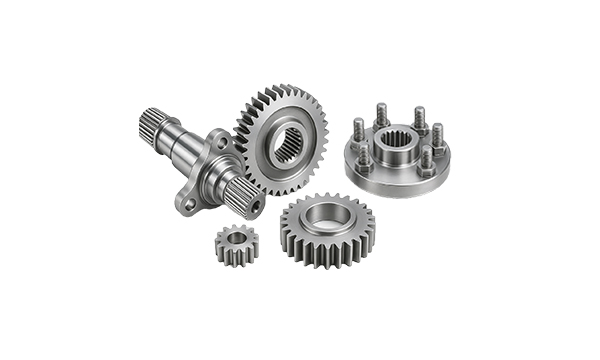
Logistics AGV Gear – Durable Automation Performance
Case Highlights
A European intralogistics provider was upgrading its pallet-handling AGVs used in large distribution centers. Existing drive units showed gear wear and noise issues after long 24/7 operation, which affected uptime and operator comfort.
DD Gear engineered a small-module planetary + helical drive gearset for the wheel-hub and in-line AGV drives. The new design fits the existing mounting envelope while delivering higher torque density, lower backlash, and quieter running, all of which are key requirements for AGV gearboxes.
Customer Background & Project Scope
Customer industry: European supplier of warehouse automation systems (AGVs and AMRs for pallet and totes handling).
Application:
Drive wheels of pallet AGVs (up to 600–800 kg load per vehicle).
In-line gear reducers for towing and conveyor-type mobile robots.
Operating profile:
24/7 logistics environment, with frequent stop–start and direction reversals.
Tight energy budgets to maximize vehicle runtime per charge.
Project goals:
Increase service life and reduce unplanned downtime of the drive unit.
Improve noise level around AGVs to keep warehouses comfortable (targeting mid-50 dB range near the drive).
Maintain existing mounting and wheel dimensions for a smooth platform upgrade.
Challenges
Gear & bearing wear in existing drives
The previous spur-gear solution, combined with undersized bearings, showed pitting and wear after extended full-load operation.
Growing backlash and micro-vibration led to harsher starts and occasional encoder-error trips.
Noise in mixed human-robot areas
Measured sound pressure around some AGVs approached high-50s to low-60s dB near drive wheels, noticeable in packing and picking zones.
Customers asked for a quieter solution, especially for night shifts.
Space & integration constraints
The OEM wanted a drop-in upgrade: same wheel diameter, shaft locations, and mounting, so that existing vehicles and fleets could be retrofitted during scheduled service with minimal redesign.
Control logic and speed profiles had to remain almost unchanged.
DD Gear Solution
1. Drive Concept & Gear Design
Planetary primary stage
DD Gear replaced the legacy spur reduction with a small-module planetary stage integrated into the wheel-hub.
Planetary drives are widely used in AGV/AMR wheels thanks to their high torque density, compact structure, low backlash and high load capacity, ideal for tight spaces and heavy loads.
Helical final stage
A short helical output stage interfaces the planetary carrier to the wheel or shaft, providing smoother torque transfer and helping to reduce audible gear noise, consistent with helical gear advantages in low-noise gearboxes.
Helix angle and face width were optimized to keep axial forces within the capability of the existing bearing arrangement.
Backlash and stiffness tuning
Target backlash limited to a few arc-minutes at the planetary stage, in line with precision planetary reducers used in automation and robotics.
System torsional stiffness improved, reducing oscillation in the closed-loop servo control at low speeds.
2. Materials & Heat Treatment
Gears
Sun, planet and ring gears manufactured from carburizing steels such as 20MnCr5 / 18CrNiMo7-6, which are widely applied in high-load planetary and automotive gearboxes due to their combination of high case hardness and tough core.
Case depth set to ~0.8–1.2 mm depending on module and tooth load.
Heat treatment & finishing
Carburizing + quenching followed by precision grinding of gear teeth where required to achieve low surface roughness and accurate flank geometry, as recommended under ISO 1328 accuracy practices.
Target surface hardness HRC 58–62 for contact fatigue resistance.
3. Manufacturing & Quality Control
Accuracy grade
Tooth profile and lead controlled to ISO 1328 Grade 5–6, suitable for high-precision, high-duty industrial drives.
Assembly & validation
Each batch checked for backlash, runout, and tooth contact patterns.
Sample drive units tested on a dedicated AGV drive rig for:
Continuous cycling under rated load to simulate >10,000 h operation.
Sound pressure level at 1 m and temperature rise at steady state.
Results
After implementing the DD Gear planetary + helical solution, the customer reported:
Noise & comfort
Average sound pressure near the drive wheel dropped into the mid-50 dB range, supporting more comfortable operation in open warehouses, consistent with modern low-noise AGV drive targets.
Reliability & maintenance
Gear and bearing-related failures decreased markedly; maintenance intervals for drive units were extended in line with the customer’s 24/7 operation goals.
Low backlash and higher stiffness improved drive stability on ramps and during tight maneuvers.
Integration
The new drive design reused existing housings and wheel dimensions, allowing both new AGVs and existing fleets to adopt the upgraded gearset without structural changes.
The platform is now used as a base design for several load classes of AGVs.
Typical Technical Specifications
Item
Parameter
Drive Layout
Planetary primary stage + helical output stage
Rated Vehicle Load
~600–800 kg per AGV (wheel-hub variant)
Rated Power Range
0.4–2.2 kW per drive module
Gear Module
m 0.8–2.0 (small-module planetary + helical)
Gear Material
20MnCr5 / 18CrNiMo7-6 carburizing steels
Case Depth
~0.8–1.2 mm
Surface Hardness
HRC 58–62
Accuracy Grade
ISO / DIN 5–6
Case Summary
By combining planetary torque density, helical low-noise meshing, and ISO-controlled accuracy, DD Gear helped this intralogistics provider:
Increase drive reliability in 24/7 warehouse operation.
Lower noise levels in areas where people and robots share space.
Upgrade an existing AGV platform without changing the frame or wheel layout.
This solution is suitable for AGVs, AMRs, warehouse shuttles and other mobile robots that need compact, quiet, and durable drive gearboxes.
Planning the next generation of warehouse AGVs or AMRs?
Contact DD Gear’s engineers to develop a custom small-module planetary drive for your mobile robots.
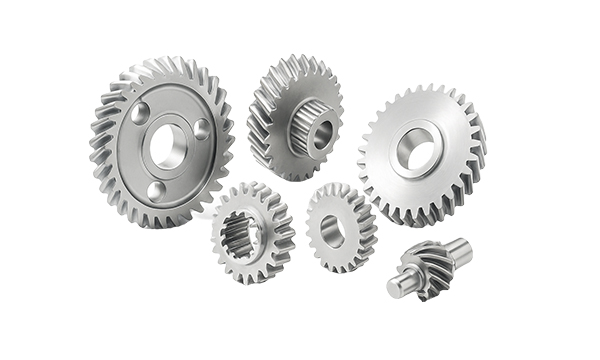
Power Tool Gear – Hardened Gears for Angle Grinders & Drills
Case Highlights
A European power tool brand supplying professional angle grinders and rotary hammers was seeing tooth breakage and high gear noise in heavy-duty use. Warranty returns on key models were higher than target, especially in construction and metal fabrication sites.
DD Gear redesigned the spur and helical gear train inside the gearhead using carburized alloy steels (20CrMnTi / 40Cr) and tighter ISO accuracy control. Similar materials and CNC processes are widely used for power-tool gears to ensure high strength and durability. After validation, the OEM recorded a clear drop in tooth-failure claims and perceived noise reduction at the operator’s ear, while keeping tool size and weight unchanged.
Customer Background & Project Scope
Customer industry: EU manufacturer of professional-grade electric angle grinders, rotary hammers, and heavy-duty drills.
Application: Gearsets in compact gearheads (typically spiral bevel + spur/helical combinations) transmitting high torque from a high-speed motor to the spindle. Spiral bevel and helical gears are common in angle grinders to handle high speed and improve smoothness.
Project goals:
Increase tooth strength and fatigue life under abusive loads (binding discs, impact on rebar, etc.).
Reduce gear noise and vibration felt at the handle.
Maintain existing housing, spindle layout, and user ergonomics.
The OEM’s existing gears were sourced from a general machine supplier, using medium-carbon steel and conventional hardening. As the brand pushed for more power in the same housing, gear durability became the bottleneck.
Challenges
Tooth breakage under overload
Field tools sent back from construction sites showed root cracks and broken teeth on pinions and bevel gears.
Failures often occurred after jam events (cut-off wheel stuck, hammer drilling in hard aggregate).
Noise and vibration at the operator’s hand
At rated speed, tools produced noticeable gear whine and vibration, increasing fatigue during long shifts.
Spur stages and less precise machining contributed to impact and noise; spur gears are known to be noisier than helical gears because teeth engage suddenly.
Volume & cost constraints
Any solution had to fit into a compact cast gearhead and remain competitive in cost, given high annual volumes.
DD Gear Solution
1. Gear Train Optimization
Spiral bevel + helical/semi-helical layout
For angle grinders, DD Gear designed spiral bevel gears at the right-angle stage and helical or semi-helical gears in the parallel stage, similar to other high-performance grinder gearsets.
Helical teeth provide higher contact ratio and smoother engagement, which is widely recognized to reduce noise and vibration versus straight spur teeth.
Tooth profile & root strength
Increased fillet radius and refined tooth thickness in critical gears to reduce stress concentration at the root.
Applied micro-geometry corrections (profile and lead modifications) so load is distributed more evenly along the tooth face, an approach commonly used to improve durability and lower noise.
2. Materials & Heat Treatment
Carburizing alloy steels for key gears
Selected 20CrMnTi and 40Cr-class steels for pinions and high-loaded gears. These low-carbon alloy steels are widely used for gears because carburizing and quenching create a hard wear-resistant case with a tough core.
Case depth around 0.6–0.8 mm, tuned to module and load.
Heat treatment & finishing
Carburizing + quenching + tempering, then gear shaving or grinding to reach the required flank accuracy and surface finish. Grinding is standard for high-precision hardened gears to control profile and avoid early failures.
Typical surface hardness HRC 58–60, with core toughness to absorb impact.
3. Manufacturing & Quality Control
Small-module precision
Modules typically in the m 0.8–1.8 range, where tool wear and distortion must be closely controlled.
Accuracy grade
Critical gears controlled to ISO 1328 Grade 6–7, aligning with typical accuracy requirements for compact industrial and tool gears.
Process checks
CNC gear measuring machine used to sample tooth profile and lead deviations.
Periodic teardown of assembled gearheads to check contact pattern and backlash, based in part on existing best practices for small power-tool gearsets.
Results
After two rounds of prototypes and lab/field validation:
Durability & claims
Warranty claims related to tooth breakage dropped noticeably on affected models after switch to DD Gear sets (internal data from the OEM’s service team).
In abuse tests (disc jam, heavy grinding on rebar), gears showed plastic deformation marks but no catastrophic tooth loss within the test window.
Noise & vibration
Test operators reported less gear whine and smoother running, especially at no-load and partial-load speeds where customers are most sensitive.
This aligns with general findings that helical and spiral bevel gears, with gradual tooth engagement, reduce impact and noise compared with spur-only designs.
Integration & cost
All improvements were achieved without enlarging the gearhead or changing the tool’s external form factor.
The OEM could keep existing housings and assembly lines, adjusting only gear suppliers and inspection plans.
Typical Technical Specifications
Representative values for a professional 125–150 mm angle grinder / rotary hammer platform.
Item
Parameter
Gear Type
Spiral bevel + spur/helical gear stages
Module Range
m 0.8–1.8
Materials
20CrMnTi, 40Cr-class alloy steels
Case Depth
~0.6–0.8 mm (carburized gears)
Surface Hardness
HRC 58–60
Processes
Forging, hobbing, carburizing, shaving / grinding
Accuracy Grade
ISO / DIN 6–7
Case Summary
By applying carburized alloy steels, optimized tooth geometry, and ISO-controlled accuracy, DD Gear helped this power-tool OEM:
Reduce tooth breakage and warranty returns on high-torque tools.
Improve noise and vibration behavior at the operator’s hand.
Keep the same compact housing and external design, simplifying rollout.
This solution fits other professional electric tools such as cut-off saws, large drills, and demolition hammers that demand compact but tough gearsets.
Upgrading gears on your next angle grinder or rotary hammer platform?
Contact DD Gear’s engineers to co-develop hardened small-module gears tailored to your torque and NVH targets.
OUR CAPABILITIES
Driving Precision Forward with
Driving Precision Forward with
Custom gear solutions
Please fill out the form below and we will get back to you as soon as possible.